
Montgomery County Criminal Court Cases
Illinois uses one Circuit Court rather than separate county and municipal trial courts. Montgomery County sits in the Fourth Judicial Circuit and the Fifth District. Felonies, misdemeanors, traffic charges, and municipal ordinance cases filed in this county therefore reach the Circuit Court. The Illinois Courts county directory links the public online-record service and identifies the courthouse at 120 N. Main Street in Hillsboro.
The Montgomery County Circuit Clerk preserves the court file and maintains the case and financial record. That role is separate from the sheriff, which keeps its own arrest and jail material, and from the State's Attorney, which makes filing decisions. A police report may describe the first allegation. The criminal docket records the charges actually filed, later amendments, hearings, disposition, and sentence. City citations from Litchfield, Hillsboro, and Nokomis also use this unified court channel.
Montgomery Court Records on Main
The county's justice offices are close together but do not hold interchangeable files. The Circuit Clerk is in Room 125 at 120 N. Main Street. The Sheriff and jail are at 140 N. Main Street. A person tracing one event may need both offices: the sheriff for custody or a sheriff-created incident report, and the clerk for the filed Montgomery County criminal court case.
Montgomery County Circuit Clerk
120 N. Main Street, Room 125
Hillsboro, IL 62049
217-532-9546
Courthouse hours: 8:00 a.m. to 4:00 p.m.
This division of custody prevents a common wrong-office request. Payment history, a judgment, or a certified disposition belongs with the clerk even if an arrest began at a city police department.
Searching Montgomery County Case Records
The county's official Circuit Clerk page and Illinois Courts directory route users to Judici's Montgomery County case search. Search by case number when it is known. For a name search, use the spelling shown in the filing and check enough docket detail to distinguish people with similar names. Online fine payment is not a substitute for reading the docket or judgment.
- Open the Montgomery County search from the official court directory or Circuit Clerk page.
- Enter the full case number, or search the party name when no number is available.
- Compare the filing year, case type, and other displayed identifiers before selecting a result.
- Read the docket in date order, noting filed charges, hearing entries, and disposition.
- Contact the Circuit Clerk when a certified copy, omitted document, or older file is needed.
| Field Label | Type | Required | Notes |
|---|---|---|---|
| Last name | Text | No | Use the filed spelling and review possible matches. |
| First name | Text | No | Add it to narrow a broad surname search. |
| Case number | Text | No | The strongest link to one Montgomery County file. |
| Case type | Filter | No | Separate criminal, traffic, and other dockets. |
| Filing year | Filter | No | Useful when the same name appears more than once. |
When Judici Shows No Case
A missing result does not settle whether an arrest occurred. Very recent allegations may not yet have produced a filed case, a name may be spelled differently, or a restricted matter may not be displayed. Start by checking the case number and county. Then call the Circuit Clerk rather than guessing that the record does not exist.
For counter access, ask whether the file is available for inspection and what copy or certification charge applies. The clerk's published payment note says personal checks drawn on banks outside Montgomery County are not accepted. Confirm current methods before ordering. If the event was federal, use PACER; an Illinois county search and a UCIA response do not cover federal court files.
According to the Montgomery County Circuit Clerk, its office is the court-record custodian. The image below shows the official county source that connects users with case information.
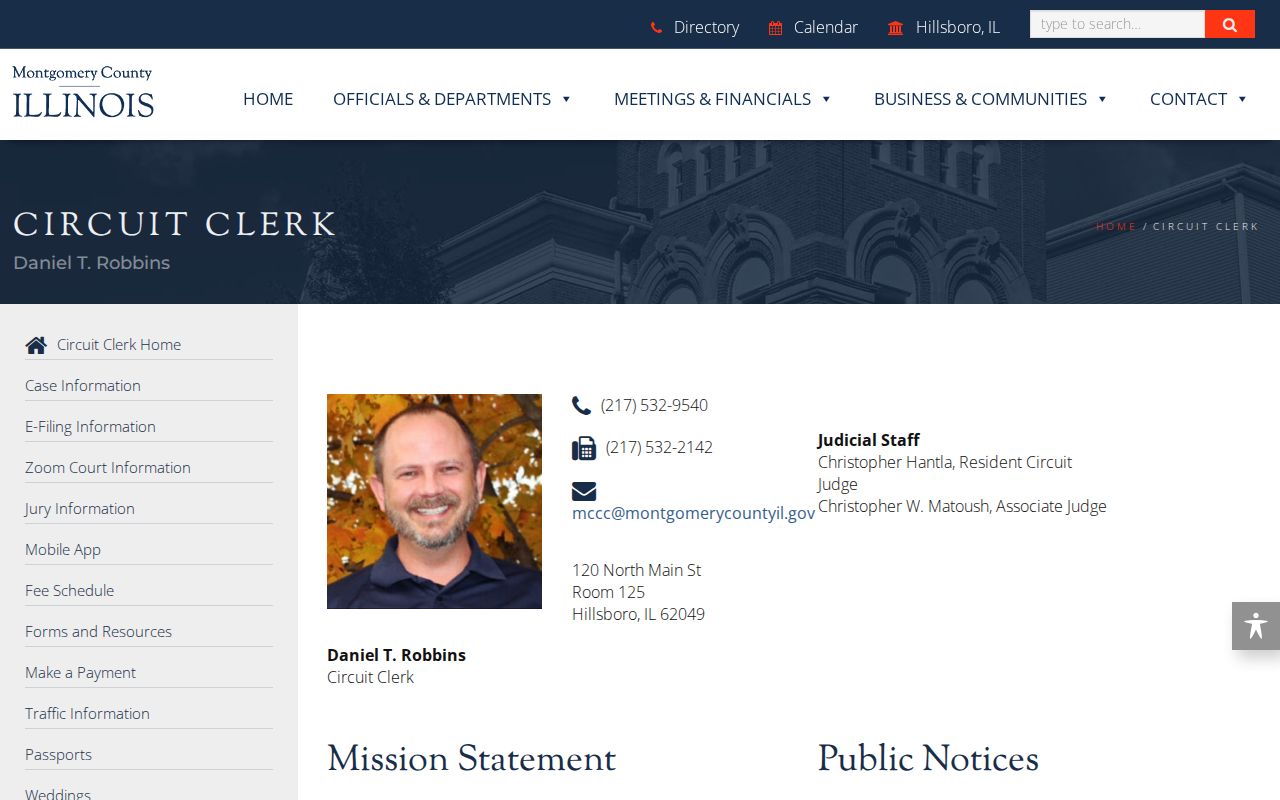
The clerk source remains the right fallback when the public index cannot answer a document or certification question.
Inside a Montgomery County Case File
A docket is an event list, while the file holds the papers behind those entries. Read count by count. The offense named at arrest may differ from the count filed by the State's Attorney, and the filed count may later be amended or dismissed. The final disposition and sentencing order are therefore more reliable for the outcome than the booking allegation.
| Case number and court | Identifies one Circuit Court matter and its filing sequence. |
|---|---|
| Charging document | States the counts the prosecutor filed and their statutory bases. |
| Docket entries | Chronological record of filings, hearings, orders, and appearances. |
| Hearing dates | Scheduled and completed court events, subject to later changes. |
| Disposition and judgment | Shows dismissal, acquittal, plea, conviction, or another result by count. |
| Sentence and conditions | Records jail, IDOC, probation, fine, or other terms imposed by the court. |
Reading Montgomery County Docket Terms
Short docket labels can hide important differences. A continuance moves an event to another date. A disposition is the court's resolution of a charge. A judgment states the formal result. A sentence states the consequence after a conviction. None should be inferred from the mere presence of a case number.
- Arraignment
- The hearing at which the charge is presented and a plea is entered.
- Disposition
- The result for a particular count, such as dismissal, acquittal, or conviction.
- Nolle prosequi
- A prosecutor's formal decision not to proceed with a charge at that time.
- Revocation
- A proceeding that asks the court to change or end probation after an alleged violation.
Compare those terms with the actual order. A docket entry can be terse, and the signed judgment may supply the needed detail. Certified proof should come from the clerk, not from a payment screen or an arrest record.
How a Criminal Case Moves
The arresting agency starts an investigative record, but the State's Attorney decides what to file. The Circuit Clerk then opens the judicial file. Motions, settings, pleas, trial events, and orders are added as the matter moves. A case may end before sentencing if the charge is dismissed or the defendant is acquitted.
Case flow: Charges Filed → Arraignment → Pretrial → Plea or Trial → Disposition → Sentencing
Remote criminal and traffic sessions may use the county's posted Zoom channel, but a meeting link is not permission to record. The county requires real names for participants, permits observers to identify themselves as “Public,” and warns that unauthorized recording can bring sanctions or contempt.
Court Files and ISP Records
A Montgomery County case file and an Illinois State Police criminal-history response serve different roles. The court file tracks one prosecution. ISP's public Uniform Conviction Information Act process disseminates qualifying conviction information reported to the state repository. It does not replace the local docket, and a local case search does not reveal a full state or federal history.
| Source | Best for | Key limit |
|---|---|---|
| Montgomery Circuit Clerk | Filed charges, docket, orders, and disposition | One county's judicial cases |
| Judici | Remote public index and docket review | Restricted or unposted material may be absent |
| ISP CHIRP | Public Illinois conviction response | Not the complete local case file |
The distinction matters when correcting data. Obtain the judgment from the clerk if a state record has the wrong disposition, then use ISP's Access and Review challenge process with the exact case number and arrest cycle.
Montgomery County Remote Court Access
Montgomery County posts a Zoom channel for remote criminal and traffic sessions. Access to a remote hearing does not turn the video into a reusable public record. Participants must use their real names, while an observer may identify as “Public.” The county warns that recording without authority can lead to sanctions or contempt.
Use the docket to confirm whether a hearing is scheduled and follow the court's current directions. A remote appearance does not replace a filed order. After the hearing, return to the Circuit Clerk record for the official entry, signed judgment, or sentence.
Case Record Access and Restrictions
Public court records are available through judicial access rules and the Circuit Clerk, while the Illinois Freedom of Information Act governs records held by executive public bodies. A FOIA request to the sheriff is not the route to a judge's case file. Ask the clerk for the public docket or document.
Sealed and expunged matters do not remain ordinary public-search results. Juvenile law-enforcement and court records are confidential under the Juvenile Court Act. Victim identifiers, medical details, Social Security numbers, and other protected information may be redacted. When one portion is restricted, that does not mean every public part of an otherwise accessible adult file disappears.
According to the Montgomery County Judici search, remote users can begin with the county index.
Always match the result to the correct person and obtain an official clerk copy when the exact wording of an order matters.